Choosing between Google Ads and Local Service Ads or LSAs can feel like picking between two equally promising paths in your digital marketing strategy. Both platforms drive lead generation, but they operate on fundamentally different models. Understanding those differences is the key to allocating your budget wisely, maximizing conversions, and building a well-rounded online presence.
Many businesses jump into Google Ads without realizing that a significant portion of their spend disappears into clicks that never convert. Meanwhile, others rely solely on LSAs and miss out on the broad reach that traditional paid search offers. The truth is, the most effective digital marketing strategies leverage both. By differentiating the two, you can turn each into a powerful engine for lead generation, covering everything from brand awareness to high‑intent job bookings.
This guide breaks down how Google Ads and LSAs work, what they cost, and how to integrate them into a single digital marketing plan that consistently fills your pipeline.
What Are Google Ads?
Google Ads is the classic pay‑per‑click or PPC platform. You bid on keywords, create ad copy, and send users to a landing page. Every time someone clicks your ad, you pay a cost per click or CPC. For industries like roofing, that CPC typically falls between $25 and $50 per click. Once on your landing page, the visitor must take an action and either fill in a form, call a number, or request a quote to become a lead.
The conversion rate from click to lead is often under 10%. That means for every 10 clicks, you might get one lead. At $25 per click, that single lead effectively costs around $250. Of course, if you optimize your landing page and boost conversion rates above 10%, your cost per lead drops. But the inherent risk remains that you pay for every visit, regardless of whether that visitor is ready to buy.
What Are Local Service Ads or LSAs?
LSAs operate on a completely different premise of pay per lead. Instead of charging for clicks, you pay only when a potential customer reaches out directly through the ad by phone call, message, or form submission. There is no landing page in between. The ad displays at the very top of search results, often with a Google Guaranteed badge that builds immediate trust.
For roofers, the cost per lead inside LSAs ranges from $50 to $250, with most falling between $50 and $150. Compared to the $250 effective cost per lead from Google Ads, LSAs can appear more affordable on the surface. But the real value lies in lead quality. LSA leads come with high purchase intent. When someone contacts you through an LSA, they are typically ready to book a job, not just browse. That means a much higher conversion rate from lead to paying customer.
The Fundamental Differences
Pricing Model:
- Google Ads: Cost per click. You pay for traffic, not outcomes. Budget is consumed by clicks that may or may not convert.
- LSAs: Cost per lead. You pay only when a qualified prospect reaches out. No waste on accidental clicks or tire‑kickers.
Lead Intent:
- Google Ads: Intent varies. A user searching roofing-repair could be researching prices, comparing companies, or just getting an idea. Your landing page must do the work of qualifying them.
- LSAs: Intent is inherently high. The act of contacting you directly through the ad signals a near‑term need. These leads convert to jobs at a significantly higher rate.
Geographic and Industry Fit:
- Google Ads: Works for nearly every business, e‑commerce included. Offers precise geographic targeting, but clicks can come from outside your service area if not set correctly.
- LSAs: Designed strictly for local, service‑based businesses such as roofers, plumbers, electricians, cleaners, and others. You must operate in a specific city or region.
Setup Complexity:
- Google Ads: Requires keyword research, ad copywriting, landing page creation, conversion tracking, and ongoing optimization. Steeper learning curve.
- LSAs: Setup is simpler. You define your service area, set a budget, and verify your business. Google manages much of the qualification.
When to Use Each Platform
- Use Google Ads when you want to capture a wide audience, build brand awareness, or target niche keywords that LSAs do not cover. For example, if you offer a specialty service like flat-roof-coating that falls outside LSA categories, Google Ads can bring that traffic. Also, Google Ads is excellent for retargeting visitors who did not call the first time.
- Use LSAs when you need immediate, high‑intent lead generation for standard local services. Roofing, HVAC, plumbing, and similar trades see the best results. Since you pay per lead, you can predict your cost per acquisition more accurately. LSAs also simplify your funnel: no landing page, no form, no friction.
How to Combine Both for Maximum ROI
The smartest digital marketing approach treats Google Ads and LSAs as complementary, not competing, channels.
- Start with LSAs for the core offering. Set a weekly budget and let LSAs capture the most ready‑to‑book customers. This gives you a steady stream of high‑intent leads at a predictable cost.
- Use Google Ads to fill the gaps. Run Google Ads for services, keywords, or areas that LSAs do not cover. Also, create campaigns targeting informational queries such as how-much-does-a-new-roof-cost to nurture prospects who are not ready to call yet. Retarget those visitors with display or call‑only ads.
- Compare lead quality side by side. Track each lead from source through to job completion. You may find that LSA leads close at 40%, while Google Ads leads close at 15%. If so, adjust budgets accordingly; however, do not drop Google Ads entirely as it still generates volume that LSAs cannot match.
- Optimize landing pages for Google Ads. Because Google Ads charges per click, every improvement in landing page conversion rate directly reduces your effective cost per lead. Test headlines, calls‑to‑action, and form length. Even moving from 8% to 12% conversion can cut your cost per lead by a third.
- Monitor cost per lead across both. Your goal is the lowest blended cost per lead combined with the highest job conversion rate. Often, the blend works better than either channel alone. For example, if LSAs deliver 10 leads at $100 each and Google Ads delivers 20 leads at $200 each, your blended cost is $167 per lead, still reasonable if those leads convert well.
Measuring Success in a Combined Strategy
Traditional metrics like click‑through rate are less meaningful when LSAs do not involve clicks. Instead, focus on:
- Cost per lead overall and per channel
- Lead‑to‑job conversion rate
- Revenue per lead - average job value
- Return on ad spend from total revenue ÷ total ad cost
Use call tracking and CRM pipelines to tag each lead by source. This data will tell you which mix of Google Ads and LSAs produces the highest revenue for your digital marketing spend.
A common mistake is comparing the upfront cost per lead from each platform without considering the downstream conversion rate. A $250 lead from Google Ads that closes 20% of the time may actually be cheaper than a $150 LSA lead that closes 50% of the time. You need to do the math on cost per acquired customer, not just cost per lead.
Common Pitfalls to Avoid
- Going all‑in on one platform: LSAs may look cheaper, but you lose coverage for less urgent searches. Google Ads may bring more volume, but you waste budget on low‑intent clicks.
- Not adjusting bids by time of day: LSAs allow you to set hours of operation. Use that to avoid paying for leads outside business hours. For Google Ads, schedule ads to align with your staff availability.
- Ignoring negative keywords in Google Ads: Even within a combined strategy, Google Ads needs constant pruning to eliminate irrelevant searches that drain your budget.
- Treating an LSA lead like a cold call: Because the intent is higher, your sales process should be streamlined to answer quickly, provide a quote, and close. Delay kills the advantage.
Learn How To Effectively Leverage Google Ads and LSA Campaigns
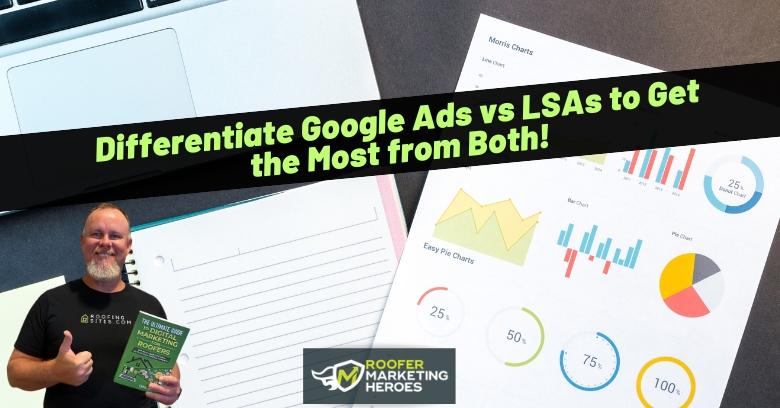
In this short video, Chris from Roofer Marketing Heroes explains the difference between a Google Ads campaign as well as Local Service Ads and how to use them both for effective lead generation without wasting marketing funds!
Conclusion
Differentiating Google Ads from Local Service Ads is not about choosing one over the other as it is about using each for what it does best. Google Ads delivers reach and flexibility for broader lead generation, while LSAs provide high-intent leads at a predictable cost per lead.
The strongest digital marketing strategies combine both by letting LSAs handle ready-to-buy customers and using Google Ads to capture the rest of the funnel. Test, track, and shift budget toward whichever channel delivers the best return, but keep both in play. That balance is what turns lead generation from a cost into a reliable growth engine.
Find out about these and other digital marketing strategies by visiting Roofer Marketing Heroes now. Click this link today to receive a complimentary copy of Chris' book, "The Ultimate Guide to Digital Marketing for Roofers." Then schedule a free marketing call with Chris and his team to get some valuable insight into marketing for roofers and what you can do to improve yours!
Challenged by Lead Generation for Roofers?
Roofer Marketing Heroes Offer Effective Roofers Digital Marketing Strategies!
Call 888-308-2168 For More Information!
Listen to the whole episode below:
Podbean: https://www.roofergrowthhacks.com/
Apple: https://podcasts.apple.com/us/podcast/roofer-growth-hacks/id1646317272
Spotify: https://open.spotify.com/show/4v5weQohba6pUzSFv7MH3s
Amazon: https://music.amazon.com/podcasts/9f2171d4-bc2d-4629-9d3c-6f3921cc4f10/roofer-growth-hacks
iHeart Radio: https://iheart.com/podcast/119165020
YouTube: https://www.youtube.com/channel/UCvfiqz7zzUWIQkgGPvx9XEw
Resources:
Roofer Marketing Heroes: https://www.roofermarketingheroes.com/
Workbook: How to Own the Google 3-Pack in Your Market in 2026
Free Book: https://go.roofermarketingheroes.com/
Let Us Help: https://roofermarketingheroes.com/schedule/
Ultimate Website Checklist: The Ultimate Digital Marketing Checklist
Connect with us!
Facebook: https://www.facebook.com/roofingsites/
Instagram: https://www.instagram.com/roofermarketingheroes/
LinkedIn: https://www.linkedin.com/company/roofermarketingheroes/
YouTube: https://www.youtube.com/@RoofingSites